66 Cover Reveal
The cover art, entitled Mechanical Flatland I, is a fine art print by Matthias A. K. Zimmermann.
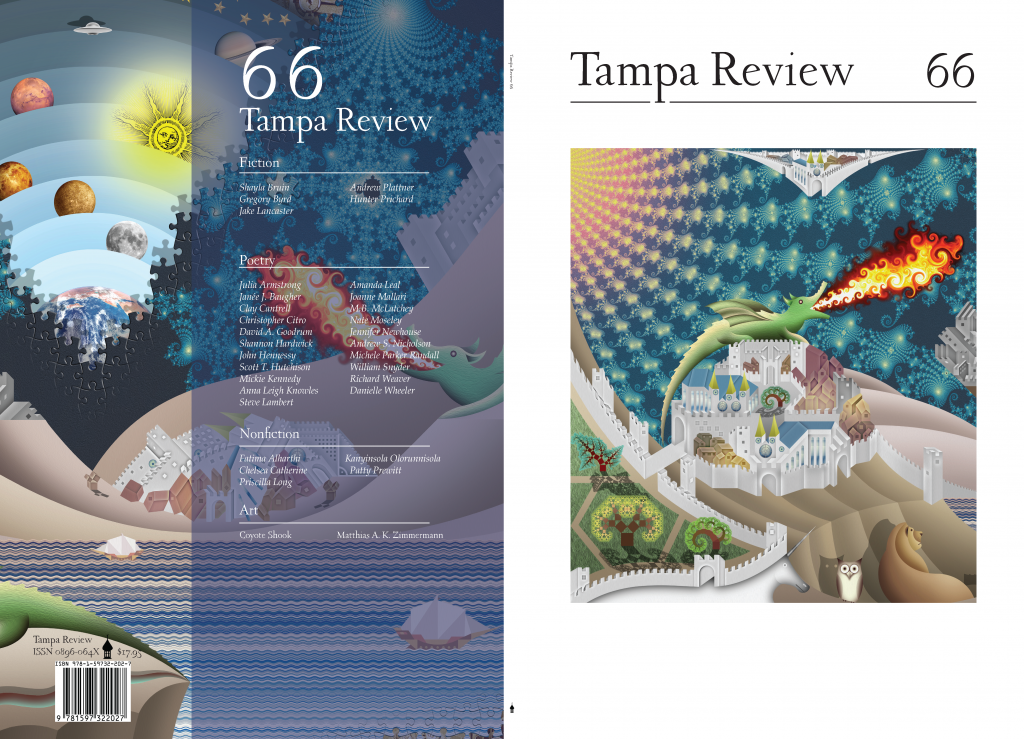
Tampa Review 66 also features art by Coyote Shook.
The cover art, entitled Mechanical Flatland I, is a fine art print by Matthias A. K. Zimmermann.
Tampa Review 66 also features art by Coyote Shook.
The Tampa Review editorial team was saddened to hear of the passing of Troy Bernardo, a recent Tampa Review contributor. Troy’s obituary can be found here. We wanted to express our heartfelt condolences and share Troy Bernardo’s nonfiction piece, “Raw,” published in Tampa Review 63/64.
When you first start eating raw oysters, you can’t taste any difference between them. The Penn Cove Selects, Belons, Olys, Kumos, they all taste the same to newcomers and casual eaters. People say it’s like learning to taste wine, in the fact that you need to learn the subtle nuances over years through hard, dedicated drinking. But I’ve been drinking wine since I was sixteen and I still can’t tell the difference between a Cab from a cardboard box and a twenty-five-dollar glass of Malbec from The Golden Steer. Oysters though? They make sense to me. Some are briny, others are kind of crunchy, some are the color of pennies, and sometimes they’re clean and crisp.
Ordering them is like a low-stakes Russian Roulette. Every so often, I’ll get half a dozen, and it’s like eating straight out of a chum bucket. Other times though, when I’m at the beach on a sunny afternoon, drinking a beer, and dressing one up with horseradish and cocktail sauce, before I slurp it out of the shell, I know it’s worth the potential Hepatitis. That all changed though on New Year’s Eve, 2018.
That year my wife and I had a lot to celebrate. We had moved to San Diego, a lifetime goal for both of us, my younger brother had just gotten married days before, and I had published my first novel. We were back in my hometown of Port Orange, Florida, and spending nights at the pool halls I grew up sneaking into and relaxing with family to wrap up an exciting year. That night we were going to my favorite restaurant, Our Deck. It’s a stereotypical beach bar and grill that looks like a large shack underneath the Dunlawton Bridge. The draw for kids is you can throw your leftovers into the mouths of dozens of catfish in the intercoastal that splash over each other for scraps. As I got older, I found it morbid that we were feeding our uneaten fish sandwiches to living fish, but when I got even older than that, I realized that’s all they really eat.
To celebrate, my wife and I decided to get a few necessities for the evening. The first item on our list was to get some good champagne. We’re not fancy, so when I say, “good,” I mean not Andre. That along with a bag of BBQ Fritos (a chip the Midwest and the West Coast don’t get for some reason) and some sweet tea. But, the pièce de résistance, and what we really wanted, were my wife’s new favorite delicacy: raw oysters. She had grown fond of them out in California where I had convinced her to try some months before. Ever since that day, whenever we saw a raw bar or we were at a nice seafood restaurant, Laura would ask if we could split a dozen. I usually ate most of them, but I didn’t mind.
By late afternoon, we had picked up most of our supplies, but we were still missing the oysters. On the way home from the liquor store we stopped at Gaff’s, the local butcher. I went in alone, knowing my wife wouldn’t appreciate the smell. Gaff’s is, what I would call, more of the blue-collar butcher in my small town. The meat is high quality and reasonably priced, but the stink of drained blood and the stench of dozens of kinds of meat can be overwhelming, especially to a city girl.
Truthfully, I felt intimidated grabbing a number and waiting there by the glass case of meats. Sure, I had bought steaks before and even some pork chops from Gaff’s but I had never bought oysters from anywhere other than a restaurant. Doing something for the first time in front of a crowd makes me feel nervous. I’m worried I’ll say the wrong thing or make an ass out of myself, even when that thing is as simple as buying oysters.
“Number seventy-six,” the meat guy said.
I walked up to the counter, the other men buying their steaks were watching me, waiting to see what I would get. They were judging me. I was sure of it. I tried to ignore them and stared at the three types of oysters they had. Living on the West Coast, I had been buying Baja and Pacific Northwest oysters, but now, I didn’t recognize any of these gulf ones.
“I-uhhh,” I paused. My hands got sweaty, and I shifted my weight from side to side.
The meat man became instantly impatient, crossing his arms and glaring at me. My eyes darted to the closest ones. I pointed and said, “Half dozen of the Gulf Coast Oysters, please.”
The meat man counted them out and put them into a plastic bag. He slapped a sticker on it and said, “Refrigerate these right when you get home, ok?” He talked condescendingly to me, and it made me mad. But I deserved it. I had no idea what I was doing, “and” he emphasized, “make sure you keep the bag open so they can breathe. Got it?”
“Of course,” I said, like he was the idiot. But I knew absolutely nothing of what he was talking about.
When I got back to the car, I put the bag of oysters in between Laura and me. While inside the store, even over the strong smell of the other meats, that stench of raw fish overpowered everything. Inside the car, it was stronger, so I tried to open the windows to help. Laura immediately noticed, and picked up the bag, peering inside.
“Can we close this?” she asked. “It smells like fish in here.”
“We can’t.”
“Why not?”
“Because they need to breathe,” I said, full of confidence.
There was an awkward pause. Even though I was watching the road, I could tell Laura was staring at me.
“Wait, but they’re dead, right?” she asked.
“I mean, I think so. Oysters live in the water. They can’t breathe air.”
Laura reached into her purse, and out of the corner of my eye I could see her frantically Googling. When I got to a stoplight I glanced over and saw what she was looking up. “Can oysters breathe air?” and “When we eat oysters are they alive?”
Laura isn’t a vegetarian. But her love for animals has become more serious as we’ve grown older. She stopped her car in the middle of the road to be with a squirrel in its dying moments after some heartless driver had struck it and kept going. She befriended a mouse in our walls, naming him Mickey, and refusing to set up traps to catch him even after he had chewed through several bags of chips. She has picked up alley cats and cooed them gently in her arms when the streets were dark and quiet after a long night of drinking.
“Ah!” she gasped. “This website says they’re alive when you eat them!”
“I feel like after you shuck them open though, they’re probably dead.”
She kept scrolling and gasping and scrolling and gasping over and over.
“Some websites say that they’re dead after you open them up, but other ones say they don’t know and there’s no way to prove they’re dead after you shuck them.”
After ten minutes of more dramatic gasping, I was turning down the road my parents live on. I finally got a chance to look at Laura. She wasn’t crying, but her eyes were misty, and she was rattled by the fact that she may have been eating animals alive. For me, this wasn’t a big deal. I’m not a hunter, but I am an avid outdoorsman, and I do fish. While I respect animals, I understand the reality of the situation. The lamb chops in the grocery store don’t grow on trees, and unless I get meat by three in the afternoon, I feel sluggish and I can’t concentrate.
“What do you want me to do?” I asked her, pulling into the driveway. “They won’t take the oysters back.”
“We have to do something,” she said, pleading with me.
We sat there for a minute, both of us thinking of something to say. After a while, I got out and grabbed the champagne and the bag of oysters, before heading inside. I put it all in the fridge, where the meatman had recommended they go right away, and opened up a beer. Laura continued to search the internet, scouring for anything that would let us know when the oysters were actually, truly dead.
“Wait,” Laura said, a lightbulb going off, “what kind of oysters are they?”
“Gulf Coast Oysters,” I said, in between sips of Jai Alai.
“Like the Gulf of Mexico?”
“Yeah. Why?”
“Isn’t that where we are now?” she asked.
“What do you mean?”
“The Gulf of Mexico is next to Florida, isn’t it?”
“The Gulf is on the west side, hun,” I said. “We’re on the Atlantic side.”
“But the Gulf Stream goes by here.”
My parents, realizing we were home, came out into the kitchen with us. They could tell Laura was upset, but didn’t know about what.
“What are you getting at?” I asked.
“I’m saying, let’s release them.”
“How?”
“We’re going to Our Deck tonight, right? That’s on the water. Let’s take the oysters and set them free.”
It wouldn’t be the ocean per se. It was under the Daytona Beach Bridge, and it was the intercoastal where the water was murky and dirty.
“Hun, they’ll probably die if we throw them in there,” I said.
“Well, they’ll definitely die if we eat them.”
My parents were starting to realize what was happening, and while they weren’t making fun of Laura, they exchanged confused glances. My dad had already started laughing.
“So,” Dad said, “you’re going to throw the oysters you just bought into the water during dinner?”
“Well, we don’t have to do that,” Laura said. “Troy could still eat the oysters if he wants to.”
Laura and I hadn’t been married that long, but I knew better than to fall for this trap.
“No, that’s ok,” I said. “You’ve kind of killed the overall experience anyways.”
Later that night, we pulled into the restaurant under the bridge. It’s just a gravel parking lot that has a short, old fishing dock next to a marina. Laura, me, my parents, and my youngest brother, all walked down the dock together. The moon was a small waning crescent, but the lights on the bridge and from across the intercoastal made the water glint with both artificial and natural light. The only sounds were catfish jumping and passing cars overhead.
Laura reached into the bag first and picked one of the oysters out. She looked at it, examining its curves in the near dark. “Do you think they’ll really die?” she asked.
“Yeah,” I said, “but I really don’t know.”
Without hesitating, she cocked her arm back and threw it as far as she could into the channel. I grabbed one and did the same, and even though I asked my parents and brother if they wanted to throw one as well, they didn’t want any part of it.
Laura threw the last one and stared out at the water until the ripples faded and only the small waves from the wind were there. I turned to my wife and she was smiling in the weak light, and she deserved to smile. She had done something that was, at least to me, very brave. That day, it was more important for her to try and do the right thing and look silly than sell out and be what everyone else expected.
We all went to Our Deck for dinner. There were no guilt trips from Laura or teasing from my family. I did point out the irony of how we ate pounds of seafood, but that night I passed on the oysters.
The Tampa Review editorial team is excited to announce that our guest judge, Evan James, has selected a winner for the Danahy Prize for short fiction.
This year’s winning story is “Security” by Shayla Bruin. Bruin is a writer living in Chicago, Illinois. This is her first published work.
Of the winning story, our judge, Evan James, says, “’Security’ unfolds with subtle, sophisticated narrative artistry. When a couple in the suburbs opens their door to a pair of “new neighbors,” a breathtakingly swift series of dramatic reversals and ambiguous power shifts takes place, ultimately driving them to a profound sense of uncertainty about both the world and themselves. Fully realized and written with exhilarating skill and control, its final moments resonate with potent mystery–the once-familiar stripped bare and left standing in its own undeniable strangeness.”
James also selected the following finalists:
“Kentucky Unicorn” by Thomas M. Atkinson
“Brooklyn Bridge” by Grace Shuyi Liew
Please join us in congratulating Shayla, and we hope you’ll keep us in mind when submissions open once again in the fall.
The cover art, titled Spell of Twilight States, is by Andy Kehoe.
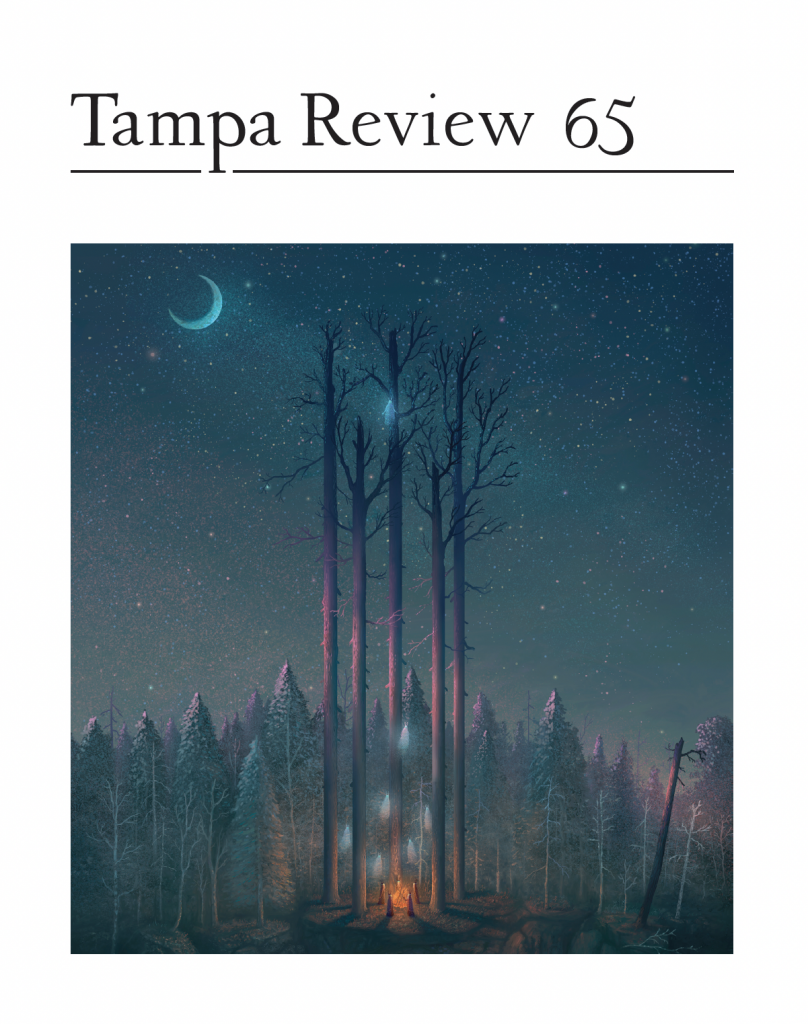
Tampa Review 65 also contains art by Sandra Hunter and Mike King.
Issue 65 is off to the printer, and we will reveal our cover soon! As part of our countdown to the new issue, art editor Leslie Vega has interviewed our cover artist, Andy Kehoe. Kehoe creates evocative work in both the traditional and digital realms. With nods to mythopoetic fantasy and folklore, his paintings feature figures so small that you may not notice them ensconced in trees and moonlight. These animal-human hybrids beckon us into Dante’s dark forest or a Grimm’s fairytale, and we really wouldn’t mind joining them.
Leslie Vega: Tell me a bit about your process. Does it differ between your paintings and your digital works? They look remarkably similar.
Andy Kehoe: The process with my traditional and digital paintings is actually pretty similar in a lot of ways, especially in the beginning stages. With both mediums, I have pieces that are very planned out, which will involve detailed sketches and some black-and-white studies. Then I have paintings that are more loose and improvisational. I’ll just start throwing paint and textures down —whether they be oil paints or pixels— and see where it takes me. I also tend to work in layers from back to front, which I do with both mediums.
The major difference is the crazy flexibility of digital work. I can move and rescale different components or change the entire color palette on the fly. There is so much freedom to experiment, readjust, and improvise. [I] love that aspect of working in digital.
Oh, and I can also finish a digital painting in days to weeks, instead of months with my traditional work. With digital, I can get my ideas down and out there into the world rather quickly, which is awesome. With traditional painting, the process is much more prolonged so my initial concept often evolves and shifts with what has inspired me and affected my life along the way. That brings a different quality to the work, which I very much love and appreciate.
LV: Your work is influenced by fantasy and sci-fi art, which has been heavily shaped by epic poetry, myth, folk tales, 19th– and 20th-century fantasy, and current speculative fiction. What are your go-to works of poetry or literature to draw upon for inspiration?
AK: Folklore and fairy tales really shaped my young, imaginative mind when I was growing up. There’s a certain indescribable feeling that those stories gave me, which was amplified by the fact that I was young, and all of life was a mystery. Much of my work is trying to tap back into that specific feeling and to bring some mystery back into people’s lives. It’s a tough thing to do these days, with all the answers to the universe at our finger tips—living a constant existence peeking behind the curtain. I feel like this breeds a real desire for worlds that encompass mystery and diverge from the mundane, such as the realms of fantasy and sci-fi.
Currently, I listen to a lot of audio books as I work, with the vast majority being in the fantasy genre. The biggest draw to fantasy writing for me is the world building. Creating a believable world where unbelievable things happen is some tricky business and also a such a tantalizing prospect. Authors like Brandon Sanderson, Scott Lynch, and Joe Abercrombie excel at creating very rich, unique, detailed worlds that you can lose yourself in. This kind of imaginative thinking really fuels my creative mind while working.
LV: And who are your favorite illustrators?
AK: Some contemporary artists I love are Aron Wiesenfeld, Kilian Eng, Boris Pelcer, and James Jean. I’m also inspired by legendary fantasy artists like Michael Whelan and Paul Lehr, and painters like 19th Century Romantic artist Caspar David Friedrich.
LV: Working both in traditional painting as well as digital, what do you think about AI generated art applications such as DALL.E 2?
AK: The debate on AI art is a tricky, layered one. Kind of a mess right now. A real mixed bag scenario. On one hand, it’s very cool technology that makes some truly amazing imagery. It’s also really fun to see what crazy things you can come up with and get immediate results.
On the other hand, it’s creating this imagery by training its AI through the use of copyrighted imagery without artists’ consent. That’s a big negative and a big problem. I’ve rarely seen any technology go so quickly from “Wow this is cool” to “This is a travesty. Burn it all down!” The vitriol for AI art in the community is intense because of this non-consensual image usage. An uproar I totally agree with.
We are definitely wading into unknown legal territory in which distinctive boundaries will (hopefully) have to be drawn. It feels like this technology is here to stay, so where those lines end up is anyone’s guess, but [it] will have ever-lasting ramifications for visual artists. I know music IP is protected very staunchly by the law, and the industry would not put up with this kind of unfettered usage one bit. I’m hoping visual art can be treated equally.
Personally, I have played around with Midjourney and I’ve used it as a tool to work through concepts and to get some fresh perspectives. But I’ve never used it to make completed art work and never would. Interestingly, I can just use my own name in the prompts to get a new concept inspired by my paintings… but that also means my copyrighted work is in the database without my consent. Since I’m the original artist, is it then OK to used unlicensed images of my own work to create something new? Like I said, it’s a mixed, convoluted bag.
LV: Do you have any projects in the works that you’d like to share?
AK: I have a Patreon page where I’ve been making a digital painting every month and posting it. That’s where I post most of my new work these days.
This year I have a couple [of] group shows, then next year I have a solo show at Outré Gallery in Melbourne, Australia. The best way to keep updated is to sign up for my newsletter, which can be found in the contact page on my website.