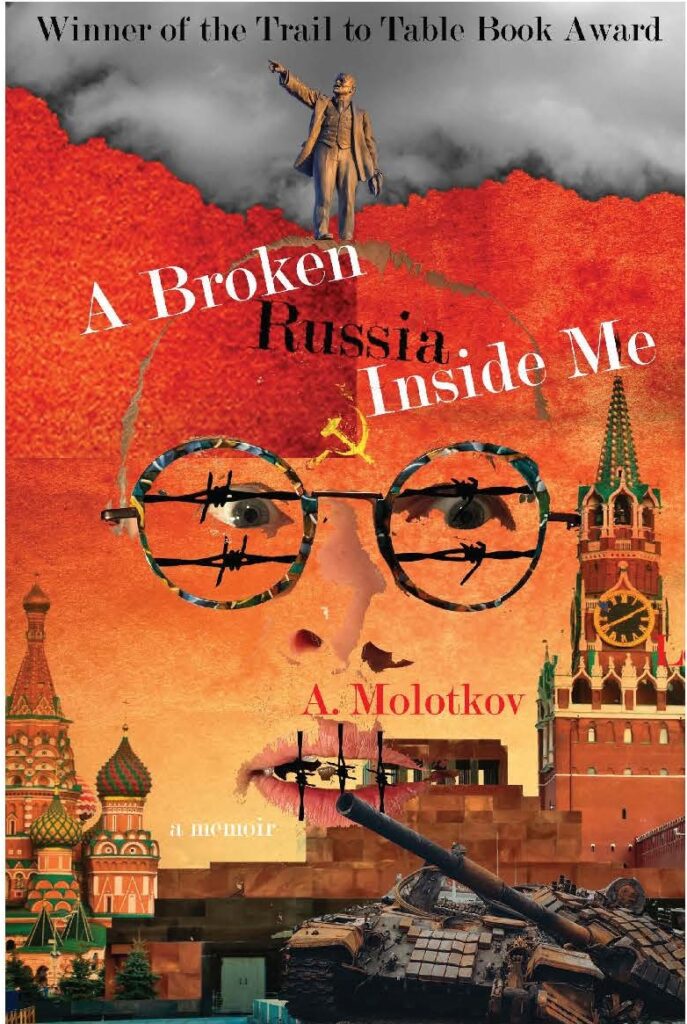
“When I’m asked why I left my country of birth, a short formula eludes me,” reflects Anatoly Molotkov in his new memoir, A Broken Russia Inside Me. “It was an absurd place devoid of freedom, initiative, and books….Is this enough?” (39). Spanning over three decades, the book, set in Russia and the United States, takes us through the author’s escape from the repression of the USSR to the author’s often idealized America.
When he leaves his native country, his family, and his friends, Molotkov is a young student of mathematics, the field both of his parents work in, with dreams of becoming a writer or a filmmaker, to live his life with freedom and artistic purpose, qualities the Soviet regime quashes. No artistic practice that isn’t in favor of the establishment is allowed to thrive there, let alone exist. After a stint in the army, where it’s dangerous even to go to the latrine at night, young Anatoly travels with a couple of friends from his native Leningrad to Moscow to request a US visa, which, if granted, will signify the freedom that is impossible to attain at home.
Tola, as he is known to his loved ones, leaves behind his parents, friends, and beloved 86-year-old Babushka, whom he will never see in person again. He also leaves behind Luba, his on-again, off-again girlfriend, to eventually also bring her over to the States, based on what seems like loyalty to his first big youthful romance rather than true love. Upon the new mother’s arrival (by this point she has given birth to a daughter with another man, a husband she has left behind), Tola asks how her trip was, and she responds, “Terrible…Can you imagine flying eighteen hours with a baby?” (60)
For Tola and Luba, cohabitation is difficult from the beginning. Arranging childcare is complicated, and they are financially strained: they roam the New York City streets at night to collect bottles to recycle in exchange for money. These passages are full of the tension and exhaustion of new immigrants. These are young people who have been forced to grow up too quickly under a totalitarian regime and are now confronted with adulthood in a completely new land where the rules of life are different, and the responsibility for their lives falls only on them.
Still, only a few months in, Anatoly loves his new life in the US. Parting ways with Luba gives him the tranquility he craves. He talks movies and books with the customers at the deli where he manages the night shift, while back home, “the USSR is no more” (65). Of his new life, he writes:
I write after I get off work at four a.m. and watch a film or two before going to work around ten in the morning….My accent is noticeable the moment I begin to speak. The cultural references I bring are vastly different from those most locals share. This doesn’t bother me. It frees me from some of the inessential conventions. It offers me a license to be myself, whoever that may be. (65)
Moloktov’s writing goes back, over and over again, to the idea of freedom. The potential, and then frustrated freedom of a nation no longer under a communist regime, yes, but personal freedom, too. After moving to the West Coast, Tola transforms his personal appearance into an extension of this freedom: he dyes his hair like a rainbow and wears multicolored clothing wherever he goes. He gets a stable administrative job, and occasionally speaks to his loved ones back in Russia. But he doesn’t miss the place. He stops writing in Russian, claiming, “What good will it do to be bound by the language of the dead Soviet empire? I’ve already given it up by moving away. My future as a Russian writer ends here” (81). There is no melancholy, no sentimentality, no mourning the potential loss of a mother tongue. This is a memoir that, by writing about the past, wants to look to the future.
But not all is perfect in Tola’s new home. As anyone who spends enough time in a place that once was new realizes, no place is perfect. After nine years in the US, Moloktov is particularly concerned about “the racism, the homelessness, the poverty, the overinflated patriotism blended with militarism, the disastrous meddling in other areas of the world…” (93). He is now married and a father to a young son, and he is conscious of the shadow these realities cast on a life that is just beginning.
One of the most pivotal events in Moloktov’s life and in this memoir is his mother’s death in Russia, not long after her first visit to the United States. Before her death, the writer has been trying to convince her to move to America, but he seems unsure of whether this move would actually work. “I’m not even certain moving to the U.S. is her best choice,” he writes. “Am I locked into a mental pattern in which my émigré guilt is supposed to be assuaged by her move to this better new environment?” (97). His mother seems hesitant, too, but in the end, the decision is made by a cancer that erupts in her body and takes her from this world on Christmas Eve, 2004. This event forces Tola to return to a country to which he feels no allegiance and where his loved ones keep dwindling. His return is a sour one anyway, full of money disputes with the man who’d married his mother later in life, and uneasy wonder at the changes that have taken place since the end of the USSR. Of St. Petersburg, he writes:
The city…brims with flashy and trashy places: bars, pubs, restaurants, stores of all sorts, many open around the clock, offering friendly service and U.S.-level prices. Incongruous cuisine fusions have taken hold, such as Italian/Sushi/Steak. On Nevsky Prospect, the city’s main avenue, a McDonald’s sits near an old bookstore, each housed in a fancy eighteenth century building likely erected by an architect of world renown. People in the city center are carefully dressed, the locals more elegant and fit than most tourists. It’s a fake paradise I won’t miss. (105)
And yet, it’s a place he returns to, at least once more, at the behest of his new partner, Laurie. They talk half-jokingly about the possibility of his being arrested by the “evil Russians” (122). They visit an eccentric friend’s dacha, as well as trendy bookstores and cafes in the city of St. Petersburg. But even through all of this, Tola’s active hatred of Russia and what it does in Ukraine starting in the second decade of the twenty first century looms. And yet, questions that continue to tie him to this place remain: what happened to his biological father? What did his adoptive father go through during the Siege of Leningrad?
These are difficult and emotional inquiries that only people in the sunset of their lives, people who live in Russia, can answer. And despite Tola’s utter distaste for the place, he perseveres. He asks the hard questions, even when he feels he should leave his ninety-year-old father be. He asks because these things still occupy an important place in his memory. Because the memories of his childhood skiing trips with his family and friends are tangled up with the places where Stalin’s atrocities were committed. Because to understand why some left and others stayed, one must honor the complexity of their history.
A Broken Russia Inside Me is a book that contends with impossible questions about identity, nationalism, and belonging head on. One gets the sense that in his account of life in the USSR and migration to the United States, the circumstances that have earned Molotkov the right to tell it have left him in a place where the only option is to tell it through unflinching, sometimes brutal, honesty. It is an inviting book that looks at complex global questions through one writer’s individual experience, a writer who studied and worked hard to find a voice and now, an audience.