TR Editor Yuly Restrepo visits Int’l Poetry Festival of Medellín
One of the most vibrant literary gatherings in the world takes place each year in Medellín, Colombia: The International Poetry Festival of Medellín or Festival Internacional de Poesía de Medellín. Founded in 1991, the Festival has consistently offered poetry as an eloquent counterweight to the violence so much associated with the city. It was awarded a Right Livelihood Award in 2006, a prize sometimes referred to as the “Alternative Nobel Prize” with a citation that it was given “for showing how creativity, beauty, free expression and community can flourish amongst and overcome even deeply entrenched fear and violence.” The award and the Festival have taken on special significance in the months since this summer’s gathering. This year when the Nobel Prize Committee announced that Colombian President Juan Manuel Santos will receive this year’s Nobel Peace Prize, the news came just days after Colombian Laureates of the Right Livelihood Award had called for a ‘Yes’ vote in the failed October referendum on the peace deal with the FARC.
Yuly

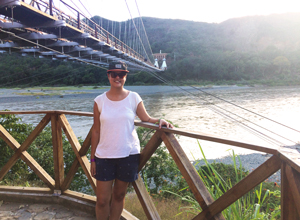
Tampa Review Fiction Editor Yuly Restrepo was born in Medellín. In 2001, at the height of Colombia’s civil war, she and her family moved to the United States, where they were granted political asylum. Yuly is now a naturalized citizen of the United States, and a writing professor at the University of Tampa. In the summer of 2016, she traveled to Medellín to work on and do research for her novel-in-progress, which is set in Colombia and deals with the country’s civil war. During her time there, she attended and wrote about the poetry festival, which coincided with the signing of a peace agreement between the Colombian government and the FARC, which has resulted in a cease fire, after over fifty years of violence. Yuly is shown at left in a photo from the trip at the foot of the Puente de Occident, or Bridge of the West, about 50 miles north of Medellín, Colombia. —Ed.

=====================================================================================================================================================================
Otraparte_1

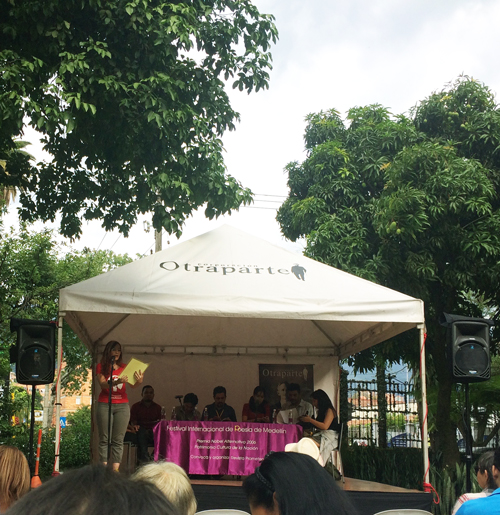
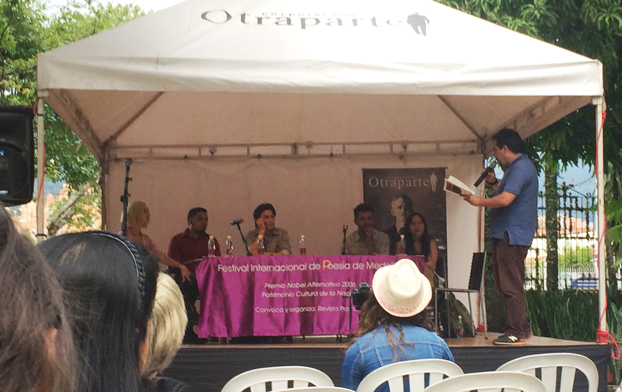
The first event I attended at this year’s 26th Annual International Poetry Festival of Medellín was a reading meant to showcase contemporary Colombian poetry. On an overcast Sunday afternoon, seven young Colombian poets gathered at the Otraparte Museum/Café, created and built for the purpose of preserving and spreading the legacy of the great Colombian writer Fernando González. They performed their work to an attentive, if small, audience. But the Festival was just getting started, and there was a significant community event competing for attendance that afternoon.

The first reader, local costumbrist poet Lina Trujillo, thanked the audience for attending on an afternoon when one of the city’s soccer teams, Deportivo Independiente Medellín, would play the championship match of the Colombian tournament. The reading featured poets from Medellín and other Colombian cities, and poets who, like many other Colombians, live outside the country. Hector Cañón stood out among them, with an undeniably environmental focus, as well as some work on the violence that has besieged Colombia for so long. This last aspect of his work is evidenced in lines such as “I come from seeing fathers and mothers crying/over the deaths of their children/with fallible anticipation.” Another standout was Fredy Yezzed, who in “The Unpublished Diary of the Viennese Philosopher Ludwig Wittgenstein” writes, “1.1 Poetry is a garden: a garden that speaks of other gardens.”
Otraparte_2

Later that night, as I rode the metro amid screams of celebrating soccer fans clad in red and blue jerseys, I thought about the absolute attention of the audience at Otraparte, and I remembered my first poetry festival six years earlier. Back then, people packed public squares and let the rain soak them, sometimes to listen to poets who read in English or Dutch, whose work no one had translated for them. I realized that, even if the numbers didn’t compare, poetry fans in Medellín could be as fervent as the people waving flags on the street and sending fireworks into the night sky to celebrate the team’s victory.

The following days reaffirmed this feeling. The festival, which took place June 18-25, 2016, featured more than 110 poets from countries ranging from Burkina Faso to Australia, including representatives from indigenous nations, such as the Mapuche from Chile and the Zoque from Mexico. It consistently had well-attended or packed venues. The poets spent their week in Medellín offering readings, lectures, workshops, and conversations to audiences from many age groups and walks of life. Additionally, the festival held film screenings, musical performances, and plays in venues ranging from universities to museums to public parks.

This year the festival had two main themes: the work of French poet Arthur Rimbaud and the Eleusinian Mysteries. To expand upon the latter, Boston University’s Carl A. P. Ruck, co-author of The Road to Eleusis: Unveiling the Secret of the Mysteries, participated in several events to celebrate the memory of this ancient city and its rites. As for Rimbaud, Colombian writers like Albeiro Montoya and Juan Manuel Roca, as well as French poet Alain Borer, discussed the poet’s work and life.

The festival, organized and sponsored by Prometeo, one of the oldest literary magazines in Colombia, has grown exponentially since its inception in 1991. That year, sixteen Colombian poets decided to hold an event called “A Day with Poetry” at the iconic Cerro Nutibara, a hill located square in the center of the city, better known for its tourist attraction, the Pueblito Paisa, a model of the traditional small Antioquian town.

Prometeo became involved in the festival the following year, when thirty-seven poets from eight European and American countries participated. That year, the event also began to integrate musical performances, as well as lectures and film screenings. The unexpected attendance, about 20,000 people total, led the organizers to improvise readings on the streets, using megaphones instead of microphones, for the people who crowded outside the packed venues.

The growth has steadily continued. In 1992, a representative from an indigenous nation, the Kuna-Tule from Panama, participated in the festival for the first time. In 1996, thanks to the success of the festival, the first School of Poetry was held, an event that has taken place ever since. In 1999, the festival offered the first prize for poetry in the Castilian language. In 2005, events from the festival aired on television for the first time, and Nobel Prize winner Wole Soyinca was one of the featured poets. In 2009, the festival was declared part of Colombia’s cultural heritage by the national government. In 2011, Pulitzer Prize winner Rita Dove participated in the festival.
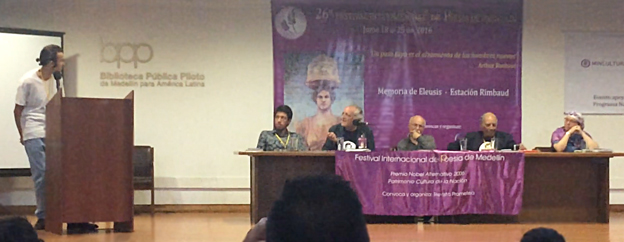
TranslatorsThis year, in addition to panels and readings focusing on the legacies of Rimbaud and Eleusis, the festival featured readings that gathered poets from diverse ages, nations, languages and styles. On Thursday evening, I attended a reading featuring Albeiro Montoya (Colombia), Adriana Paredes (Mapuche Nation, Chile), Keki Daruwalla (India), Antonio Trujillo (Venezuela), and Alain Borer (France). By now, the festival organizers have started to provide those who write in a language other than Spanish, and cannot translate their work into Spanish themselves, with both a translator and a local actor who reads their poetry for the audience in Spanish. At this particular reading, the audience was delighted to hear and understand the images in Daruwalla’s poem honoring Federico García Lorca, first in English and then in Spanish: “Sandwiched between your rivers/‘one lament and the other blood’/the land will flame like a tongue/of fiery green/threading the Sierras.” The audience also enjoyed Borer’s extremely brief, surprising poems and his delight at being in Medellín.
Mural

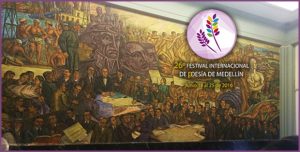
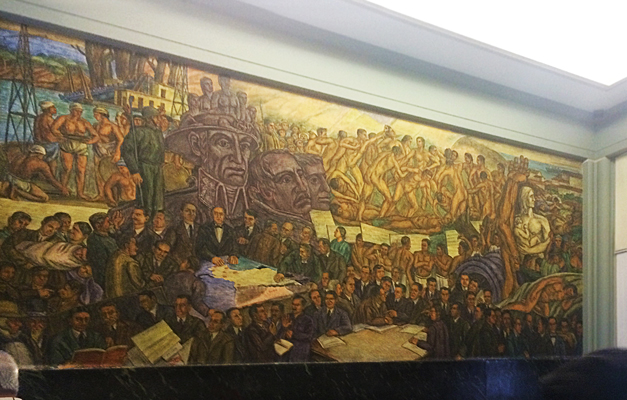
The next day I attended Colombian poet Leo Castillo’s lecture on “The Damned Poets.” The lecture took place at the Sala del Concejo of the Antioquia Museum, a room that features an imposing mural by maestro Pedro Nel Gomez entitled La República, which depicts important events in the liberation and development of the Colombian nation. The room was packed with about 150 people, and the lecture turned into a spirited debate. When it became evident that Castillo was more interested in discussing details of the poets’ private lives, such as Paul Verlaine’s proclivity for sex workers, or Rimbaud’s possible homosexuality, than about their work, the audience took it upon itself to become an active participant in the conversation and demand a better quality of work from the presenter.

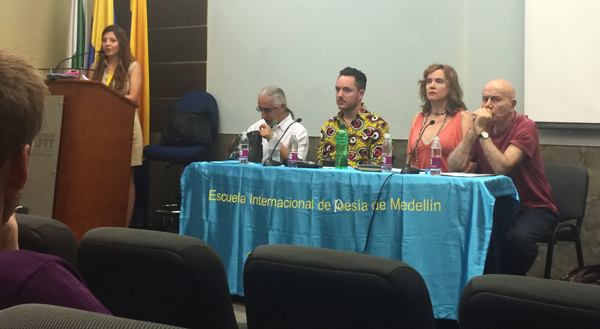
A few days later, I went to EAFIT University’s campus to listen to the work of Rubén Darío Lotero (Colombia), Judith Crispin (Australia), Hugo Mujica (Argentina), and Samm Monro, aka Comrade Fatso (Zimbabue). The Colombian poet read short vignettes from everyday Colombian life, while the Zimbabwean entertained the crowd with his spoken word style focused on the social and political ills of his country. The Australian, with her expansive, dreamlike poetry, was also well received. However, it was the Argentine, with lines such as “He fell weightless/like eyelids,/at nightfall or a leaf/when the wind rather than whip away, sways,” which he wrote about the death of his father, who won over the audience completely.
EAFIT-Univ

The closing ceremony, a reading marathon featuring most of the participating poets, took place at Parque de los Deseos, and again was packed. People in attendance wore t-shirts with Rimbaud’s likeness printed on them and carried around festival tote bags and the festival edition of Prometeo magazine, which includes work by all the participating poets, in English and Spanish, as well as Carl A. P. Ruck’s essay “Memory of Eleusis.”

I had to ask myself why in a country where the population reads an average of one book per year, this festival has such massive success, and why attendance has soared to hundreds of thousands. I’ve pondered the question in the days since the closing ceremony, and I think the answer goes back to what the poets who founded the festival had in mind when they got together for the first time in 1991. In that year, war was on every Colombian’s mind. The cartel wars, the war on drugs, the war between the guerrillas and the government. In 1991, bombings, drive-by shootings, political assassinations, and massacres in public areas were daily occurrences in Medellín. War was on everyone’s lips, and fear was in everyone’s thoughts. So the festival came as a response to that fear. It started because the city’s spirit was broken and in dire need of repair. It began because poetry was a way to create and reaffirm life in a place where death was our daily bread. In a city that still had some of its darkest days ahead, poetry served as a way to get closer to the light. It has been so for twenty-six years in a row.

On June 23, 2016, during the week of the festival, the Colombian government and the FARC signed a peace agreement, after more than fifty years of civil war. The rebels agreed to a final cease fire and future reintegration into society. The country met the possibility of peace with joy and trepidation. After all, the war has left hundreds of thousands dead and millions displaced from their homes. It has left more than fifty years of destruction and suffering. The trepidation will continue for some time to come, but so will the joy. And through it all, in the city of Medellín, there will remain the life-giving power of poetry—and the masses who will come to be part of an event that stands against war and fear and death.
An Email from Malcolm Garcia

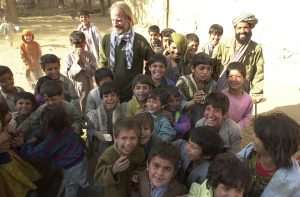
Malcolm Garcia in a village in Afghanistan. Photo by Peter Andrew Bosch, from Tampa Review 33/34, 2007.

Malcolm Garcia in a village in Afghanistan. Photo by Peter Andrew Bosch, from Tampa Review 33/34, 2007.

One of the highlights of Tampa Review 49 is a new essay by J. Malcolm Garcia, who continues to witness and reflect on trouble spots around the world. His latest contribution, “Praying in Reyhanli,” was written after spending time with refugees in Syria and Turkey. 

Recent events have only underscored the importance of intelligent, unbiased reporting from this part of the world.  The horrific beheadings of journalists Steven Sotloff and James Foley reminded me of the imminent danger that Malcolm faces in his freelance work. As I unpacked the first hardback copies of Tampa Review 49 from the printer while listening to some of the latest reports on NPR, I found myself wondering where Malcolm might be at the moment and what new reporting assignments he had in mind for himself.  I decided I’d ask him, and I thought that readers might also find his reply interesting.  With his permission,  I’m posting it here on Tampa Review Online, where it can serve as an introduction and a supplement to his work on our printed pages. 

-Richard Mathews

========================================================================

Dear Richard,

Thank you for your note. Some flattering news: “My Middle Age” [published in Tampa Review 45/46] was named a “notable” essay in The Best American Essays 2014. Thank you again for accepting it for publication and putting up with the odd proofreading process we went through while I was in Syria and Turkey.

I appreciate your offer to write an updated commentary or add some recent notes on developments in the Middle East. The translator I worked with has returned to Syria and we’ve been communicating via Facebook. I’ll try to reach him via Skype, and perhaps I could put together some sort of essay about our experiences. At the same time, the translator I worked with in Kabul, where I just returned from, is under threat by pro-Islamists for working with a Westerner. These two developments together might make for interesting reading.

If I had to categorize myself, I’d say I’m kind of a grassroots writer. Rather than offer my personal thoughts, I’d like to get the commentary from the ground, from the people feeling it, if that makes sense. I’m not much of a pundit.

I’m working on a couple of things—a trip to Cambodia to write about deportees there, and in a similar vein, I’m looking at going to Tijuana to write about deported veterans. These are guys who served honorably in the U.S. armed forces, got out, committed a felony (usually drug-related), and because they are not citizens they are deported to their country of origin, which they know about as well as you and I would,  since they grew up in the States but just weren’t citizens because they had been born in another country. It’s a substantial story, and very few people are aware of it.

Also, I’m looking at Iraq. But it’s a matter of balancing logistics and costs. I’m not much of a freelancer in terms of livelihood. My outlets are mostly small magazines that through no fault of their own cannot pay much, if at all. I’m blessed to have been published in Tampa Review and other small magazines, because the editors allow and even encourage creative approaches to nonfiction storytelling. So I have no complaints. But as a result I work temp jobs in-between travels to earn the money to go.

I had one commercial gig that paid handsomely, but the editors butchered the story and they made it clear I had no input in the process. So, I’ve sworn off them. And as a result of sticking to my voice despite its faults, I have a “notable” essay of which I am very proud in a magazine I’m very proud to be in . . . and if there is an afterlife, I hope my good friend Tom (the subject of “My Middle Age,” if you recall) is proud of this, too.

Well, I’ve prattled on longer than you asked or have time for, so I’ll close now, but I’ll get back to you about the commentary and let you know when I think I can get you something. Right now I’m working up my new Afghanistan piece (I spent three weeks with street children), but I’ll make time for TR, no problem. It is my hope to submit again to you next year when one or all of these proposed trips I described jells. I know I’ll have more than one story out of each of them, and I’d be pleased to be considered for publication again in Tampa Review.

All best,

Malcolm

Saying Yes To Small Things: An Interview With Vanessa Blakeslee

vanessa_blakeslee


Vanessa Blakeslee writes stories that stay with you. Whether it’s a pop star on the verge of suicide, a drug-addicted doctor struggling with a wife’s death, or the loving mother doing her best to cope with a troubled son she both fears and wants desperately to save, Blakeslee’s first book Train Shots hits the reader again and again with soul-stirring prose.

Vanessa lives in Maitland, Florida and earned her MFA from Vermont College of Fine Arts. Her writing has appeared in Green Mountains Review, Kenyon Review Online, The Paris Review Online, Split Lip Magazine, The Southern Review and many others. She was the winner of the inaugural Bosque Fiction Prize, and has been awarded grants and residencies from The Virginia Center for the Creative Arts, The Banff Centre, Ledig House, Yaddo, and the Ragdale Foundation. In 2013, she received the Individual Artist Fellowship in Literature from the Florida Division of Cultural Affairs.

I recently had the good fortune of meeting Vanessa at Functionally Literate in Orlando, where she was reading one of the stories from her new book, Train Shots, now available from Burrow Press. We set up this interview for a few days later.

Coe Douglas (Tampa Review Online): After reading Train Shots, I noticed that many of the stories deal with primal issues – life and death, spirituality and morality, in a sense, an interesting sense, sex, identity. All the really good stuff! Do you draw on life experiences as catalysts for your fiction? Or, what other cues act as catalysts for your stories?

Vanessa Blakeslee: One of the best teachers I ever had was Doug Glover, who teaches at Vermont College. I studied with him my second semester into the program, and at the time I had really hit a wall when it came to choosing situations to write about. I hadn’t yet really learned to ask myself, “What matters?” In one of his letters to me, he asked, “Where are the great stories about love and death?” I remember reading that and sitting back, awestruck. Where were they, indeed? I see this in my undergrad students all the time; they’ll come up with a thin conflict scenario between two or three people, and either skim the surface of what the real issue is driving the story or evade it altogether. That’s because diving into and exploring the gritty ugliness in the ways human beings act toward one another is uncomfortable, often scary.
trainshots

CD: Agreed.

VB: So I suppose once that sank in, I realized there was no way of shirking those subjects anymore — if I wanted to become the writer I wanted so desperately to be, I had to find the courage within to do so. Isn’t it Flannery O’Connor who has that great quote about the artist having to stare at the ugliness in life?

CD: I believe so. And this does offer a deep reservoir for fiction.

VB: But yes, to answer your question, I draw on life experiences and make them up. From my life, the lives of those around me, stories in the news media, you name it. So watch out!

CD: A story like “Barbecue Rabbit” is dark but so deeply compelling because we can all feel the anguish of the mom as she struggles to love this troubled son at all costs. Huge potential costs.

VB: That story is a great example of what we were just discussing, in terms of inspiration. I based it on a few anecdotes I’d heard over the grapevine of two different cousins, one who is very troubled and was later diagnosed as bipolar, but that wasn’t known then. Couple that with all the shootings happening in our culture by disturbed young white males, and I got to wondering what family circumstances might start a kid off on that
direction. And how much power or blame a parent may or may not have within that circumstance.

CD: You capture that beautifully. It’s a haunting story.

VB: Thank you. I also wrote it in October, intending for it to be somewhat of a Halloween story – not so much a tale in the tradition of Poe, but psychologically thrilling.

CD: Another aspect of the stories I really enjoyed was the strong sense of place. Central Florida for sure. But also Costa Rica. I was curious about your process in that regard. And, how that might color the story. I read somewhere that “Hospice of the Au Pair” began in Florida and you moved it. Good choice I think.

VB: Yes, oh, it changed dramatically. Recently I came across the old drafts of where the idea first began, and you wouldn’t even recognize that story. At first I was writing about a college girl au pair who was stealing from her wealthy employers and gets caught. It was called, “The Scholarship Student Learns about Debt” and it was just awful.

In its next incarnation, I abandoned that part and just wrote about the morphine addicted doctor with the dying wife, who getting the young twenty-something au pair pregnant — again, set in Florida — and it was just too Real Housewives or something.

My advisor at the time, Robin Hemley, asked me why didn’t I try setting the story in Costa Rica, since I was living there that semester. And bingo, the story snapped into place.

I think you have to look out for that as a writer – maybe your writing itself isn’t cliche, but the scenario is. How might you change it up to make it fresh and interesting?

CD: There is a great lesson here in perseverance as well. Sticking with a story, even when it seems off track.

VB: Oh yes. Like I said, you wouldn’t even recognize the early drafts of it. Keeping work around in drawers, taking it out later and changing it up drastically can be really worthwhile. Another twist on this approach is to change up the characters in some big way: gender, age, social class, etc.

CD: It really gets at finding those techniques that spark and fuel the imagination.

VB: You can really have fun with it. The sky’s the limit. And the fun is what breathes life into writing you might otherwise perceive as dead on the page, dead to you.

CD: Giving ourselves as writers room to play.

VB: That’s paramount. I’m a big believer in the Robert Frost saying, “No tears for the writer, no tears for the reader,” etc. But if you’re having fun on the page, chances are that will invigorate your language, too, and then, look out, you’re really having a good time! And guess what, so is the reader.

I’ll add that you should look for that quality in the writers you read and study, too – look for who is really having fun on the page. I was reading Barry Hannah at the time, and his work definitely influenced that story and a few others. He reawakened my own sense of kookiness and it showed up on the page.

CD: He’s on my ever-expanding MFA reading list!

VB: Great. He’s so good!

CD: So, you work hard on these stories. Workshop them, publish them, and then it’s book time. Your first collection has gotten great reviews, made lots of lists including being named one of the five books to take on a flight, most anticipated reads of 2014, you were listed as one of ten women writers we should all know. How did it come about with the great folks at Burrow Press.

VB: Well, it’s a good example of the importance of saying yes to small things, and small things leading to something bigger. Shortly after I first met Ryan Rivas – I can’t remember if this was before or after I was solicited to take part in the “15 Views of Orlando” anthology, but around that time – he asked me if I’d be up for writing a blog column for their online journal, the Burrow Press Review. At first I hemmed and hawwed, said how I didn’t really think I had time, was focused on another revision on my novel, going to such-and-such residency, etc. But Ryan didn’t let me off that easily; he was looking for good bloggers. I gave in and came up with “The Shimmying Writer” column, where I talked about how writing and dance were similar to each other (I was in a dance troupe at the time). And I loved it, had no problem turning in essays every month, sometimes every couple of weeks. So through that experience, I think Ryan came to know me as a hard worker who could meet deadlines and take editorial direction, for one. At the same time it helped that I kept placing stories in well-regarded journals. Eventually the column ended when Burrow Press Review changed their online format, and Ryan and I talked in summer 2012 about him taking a look at my collection.

Now, might that have happened anyway even if I hadn’t written the blog column for Burrow Press Review? Maybe. But it certainly paved the way for us to get to know each other as writer/editor and know that we had a good working relationship.

CD: Writing is truly a relationship business. Not only with publishers and editors, but with the people we hope will read our work.

VB: And that makes sense, doesn’t it? For what is the act of writing and reading, if not human connection?

CD: It’s what I like best about fiction. The collaboration between writer and reader to animate the universe we’ve put on the page.

VB: Yes, I think that’s where the power lies. I feel like we often talk about fiction and the “why” behind it as uncovering some kind of greater truth, but what we don’t talk about as often is that intimacy between writer and reader – the magic of two minds meeting across time and space.

CD: Couldn’t agree more. And when reading for an audience this takes on a different vibe. I actually got to see you read last weekend at Functionally Literate in Orlando.

VB: That’s right. What a varied and engaging show.

CD: Great event. I enjoyed hearing you read “Welcome, Lost Dogs.”

VB: Thank you. It felt like the right audience and venue for that story.

CD: So, now with a book out. Is there a tour coming? More readings?

VB: There’ll be many more stops this year. For the remainder of April and beginning of May, I’ll be reading throughout central Florida, at Books & Books in Miami, and then heading up to Charleston to read at Blue Bicycle Books on May 7th. Charleston’s got a great lit scene, I hear, so I hope we get a good crowd.

Not sure where summer will bring me yet, but in the fall I’ll likely be back in Florida and visiting the areas I haven’t gotten to yet: namely Tampa and the Other Words Conference in St. Augustine, and hopefully a few more locations.

CD: Great. And what’s your next writing project?

VB: I’ve got a couple of them on the back-burner, since most of my energies right now have been going to getting this baby into the world. I’ve almost got enough stories for a second collection, so I’m planning on revisiting those as soon as I can, when the semester’s over. Then I have a novel-in-stories of Italian-American fiction to finish. I also have a vision for a dystopic novel set in Florida, akin to Margaret Atwood’s MaddAddam series, that I’m really eager to get down. But I like novels to brew for awhile – like years – so I’m okay with waiting.

CD: Lots to look forward to. I want to thank you for taking the time to chat. The new collection is fantastic.

VB: Thanks so much. It was a pleasure talking with you. It’s very humbling and rewarding to have the collection so well received by so many readers.

CD: See you around the writers’ circuit! Maybe the next Functionally Literate?

VB: You will if I’m in town. Or maybe I’ll swing by the Tampa residency!

CD: Yes! That would be great. 

Keep up with Vanessa at vanessablakeslee.com.


Our Urgent Need to Share

The need to immediately share information on social media is a curious subject in our home. It’s the urgency that tickles me, the act of posting on the Internet before thinking through the consequences. With access to Facebook, Twitter, and Instagram getting easier with each new mobile gadget on the market, there is no surprise that issues arise in the area of justice. A recent case in Miami, Florida, proves that point after a man’s daughter loses her father’s $80,000 settlement by blabbing the news on Facebook. The settlement language included a confidentiality agreement. He broke the agreement by telling his daughter. She felt the urgent need to share it with her 1,200+ Facebook followers.

The problem isn’t about reading the fine print or getting a better lawyer. The problem isn’t having 1,200+ Facebook followers. (Notice the term “followers” now replaces the term “friends.”) It’s about the urgency to share information in social media without first considering the consequences. The repercussion in this case was that Dad lost $80,000. Lesson learned. Hearing it on the radio gave us something to chuckle about.

But what are the consequences in the publishing world?

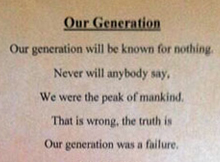
Recently, a poem, “Our Generation,” written by eighth-grader Jordan Nichols, went viral. The entire poem, title, and the author’s name were captured in a photo and tweeted by his brother, Derek Nichols. The picture was retweeted and shared on Facebook immediately. Because of the viral status, the work was then posted on sites such as The Independent and Media Bistro’s Galley Cat. Bloggers picked it up and copied the words into their blogs labeling it as “genius,” “unbelievably wise,” and “a declaration of hope,” because when read a second time from the bottom up, the perspective changes. The San Francisco Times writes that it is “the most significant poem of this decade.” I guess they didn’t bother to read the original, “Lost Generation,” written and videotaped as an AARP contest entry in 2007 by Jonathan Reed, also of this decade. According to Yesmagazine.org, Reed’s video was inspired by the Argentinian political advertisement “The Truth” by RECREAR.

It shouldn’t matter that someone found the original. Kudos to Reed, by the way, for winning second place. It shouldn’t matter that Nichols’ poem is an imitation poem. Imitation poems are nothing new to the world of poetry. I’ve seen them published in The New Yorker. It was probably an assignment at school. My daughter had the same assignment last week. I did one in college.

What matters is that Jordan wrote it and his brother killed it by posting it on Twitter. Whether Jordan approved of sharing his work, or not, is only part of the problem. There was an urgency felt by his brother to share, so he did what most people today are doing. He took a picture and posted it. The act probably didn’t take more than a minute. Posting pictures is easy to do. One minute doesn’t give you much time to think about the consequences. His post retweeted over 144,000 times. The media picked up the buzz. The original was found. Now there are posters out there labeling the work as “deceptively simple,” and worse, “plagiarized,” all because it was presented to society so quickly that honest literary review became impossible. Did Jordan ask for that? We don’t know, because he didn’t post it.

Could Jordan sell his imitation poem to a magazine editor or publisher in the future? Maybe, but “Our Generation” is now considered published. Chances are that a publication may reprint it one day, but they won’t pay for a work that’s already been circulated via the Internet. He can thank his brother for that. It’s dead now.

Writers face this risk when sharing their own work on social media sites. Once it’s shared, we have no control over how many times it is viewed, retweeted, or reposted. This lack of control is the reason that work posted via the Internet is considered published. The better-paying markets will not accept previously published poems or stories. So, when you post your work to the Internet, you have to consider that you’re giving it away. If that is your intention, then wonderful. But if you want to sell your work, don’t post it.

Did Jordan’s brother know that by tweeting a picture of the entire poem, title, and author’s name, that he was in fact publishing his brother’s work on the Internet? I’m going to bet that in his urgency to publicly share, he didn’t take the time to think about it. But that’s an issue for another day.

So, to the author of this clever imitation poem, I say, Great work, young man. I hope you received a decent grade for not only selecting an award-winning poem to imitate, but also for recreating a hopeful and memorable message for your generation.

To the author’s brother, I say, How dare you?