David Salner

THE BURNING

by David Salner

I had been stacking forty-pound ingots in the heat, working to the point of exhaustion. I walked to the open furnace, attracted by the way it shone in the darkness, fascinated by the peaceful appearance of the liquid, so ordinary, like a pool of water.

This was my first shift in the foundry, my first view of a furnace of magnesium at 1300f.

A waist-high rim of bricks was all that separated me from the glowing pool inches away. As I stared, a change took shape in the depths of the furnace. The core was now suffused with a faint rose shadow that deepened before my eyes, as if the metal had come alive, blushing.

I stood over the furnace as my face baked, my skin a crust of heat. I was transfixed by the flux, now blood-red, but changing again, rising, blooming from the depths of the coloration, swelling until the silver skin of the metal began to split. An open wound, then another, another. Dozens of strawberry blisters riddled the sheen.

“Turn that fucking furnace down,” a voice boomed. “The damn metal’s burning.”

Someone in another room dialed the furnace temperature down, and the blush began to subside. That individual was not a doctor but, I later discovered, a metal refinery operator, an MRO. Meanwhile, someone else ran to the rim of bricks and sprinkled a dust of lemon-colored sulfur on the blisters, choking the burns, healing the skin.

Magnesium is not so much a metal as a creature that needs to be nursed.

The furnace was peaceful again. A silver sheen covered it, hiding its suffering flesh.

============================================================================
David SalnerDavid Salner’s second book, Working Here, was published by Minnesota State University’s Rooster Hill Press. His poetry appears in recent issues of The Iowa Review, Poetry Daily, and Threepenny Review. He worked for 25 years as an iron ore miner, magnesium plant worker, and general laborer.

Joanne M. Clarkson

NEWS PEOPLE

by Joanne M. Clarkson

Skin made of newspaper: black on 
     white with patches of war, murder, 
weather and empty crossword 
         boxes.  They stand 

face forward with legs spread, verbs 
      for eyes, seeing the  
doing, and curved dark 
         tears.  The Daily. 

But oh to be the Sunday Comics. 

Bent at the waist, they ride the northbound 
     bus, left by a child tired from a day, 
a long journey of unwanted travel. 

A grandmother who always carries 
     scissors in her purse to snip out 
clothing tags or carve a person. 

 A man in the next seat who reads 
         without seeing then gladly 
 hands the world over 
               to be re-shaped into 

pirates and movie starlets or a family 
      with too many mothers. 

And even in the dark garage 
     where they are swept 
and crumpled, they still 
      shout from bins in rain 

 or,  burning, whisper partial 
      names of those 
convicted, those set free.

============================================================================

Joanne M ClarksonJoanne M. Clarkson is the author of two collections of poems: Pacing the Moon (Chantry Press) and Crossing Without Daughters (March Street Press). Her work has appeared recently in Paterson Literary Review, Valparaiso Review, Caesura, and Hospital Drive. She holds a Master’s Degree in English and has taught, but currently works as a Registered Nurse specializing in Hospice and Community Nursing. Joanne lives in Olympia, Washington, with her husband, James.

An Interview with Featured Artist Jon Rodriguez

By Andi Tomassi and Jon Rodriguez

Tampa Review Online: How long have you been a working artist? What caused you to move in this direction?
Jon Rodriguez: I’ve been a working artist for about seven years now. Classic Disney animation, comic books, and films were a huge inspiration for me growing up.
TROn: I know you are an Art Director at Dunn&Co. What’s that like? And do you feel it has influenced your fine art process in any way?
JR: Working for Dunn&Co. is a great experience. I enjoy the process of conceptualizing and executing ad campaigns in a collaborative environment, and being surrounded by talented people. I feel that working in the advertising industry helps me as a creative on multiple levels. Advertising has a story element that strives to connect people on a personal level through various forms of mediums. Connecting to one another is a powerful human desire. I’m grateful that I create connections for a living.
TROn: How would you describe your studio process? What are your rituals?
JR: I usually start with a basic idea and try to break down the meaning to its core. After deconstructing my concept, I try to think of new ways to experience it—a different point of view that’s refreshing and unique. Concept dictates design. When I’m happy with the main idea, I use its concept as a roadmap to the final design. This process is always different, but I try to work within these parameters.
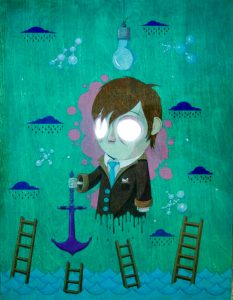
TROn: Jon, in regards to fine art, you have been working in the same style for quite a while now, using characters that are all seemingly tragic. Can you give us a little insight into how these characters evolved and also how they connect to you personally?
JR: Since these characters reflect different attributes of myself, they are evolving with me constantly. Each character has their own distinct traits that reflect different aspects that mirror where I’m currently at in life. Some are hopeful and some are tragic. These characters act as a way to share a deep truth about myself, in hopes of helping people see a truth in them.
TROn: You’ve told me that Edward Gorey had a big influence on you. What would you say are your other influences?
JR: Other influences include shamanism, eastern philosophy, symbolism, and ice cream.
TROn: Which is your personal favorite piece?
JR: My favorite piece is “The Sleepy Slave.” It’s one of the largest pieces I’ve made and the most time-consuming. I worked on it continuously for over a month and put a lot of sweat into it.
TROn: What if our viewers want more of Jon Rodriguez? Where can they find your work?
JR: They can see my work at jon-rodriguez.com.

AscensionAscension

Necromancer

Necromancer

Greedy Ghouls

Greedy Ghouls

Sleepy Slave

Sleepy Slave

The Keepers

The Keepers

Dreary Drone

Dreary Drone

============================================================================
Jon RodriguezJon Rodriguez is an art director, graphic designer, and illustrator living and working in the Tampa Bay area. He’s been an artist for most of his life and has exhibited in galleries across the U.S. He has also worked on campaigns for local businesses, as well as large brands, and everything in between. Some of his experience includes Toyota, Dunkin’ Donuts, Tampa Bay Lightning, Shoe Carnival, Buffalo Wild Wings, Costa Rica Tourism, and Baskin Robbins. He strives to be highly conceptual and produce eye-catching visuals that will capture the attention of all audiences.

Andi Tomassi graduated from the University of South Florida with a dual-major BA in Visual & Performing Arts and Art Education. She is currently an MFA candidate at the University of Tampa.

Joey Poole

INSTINCT IN THE ABSENCE OF THOUGHT

or THE CURIOUS CASE OF THE DROWNING CATERPILLAR

by Joey Poole

Recently, in the midst of a brutal July heat wave, I noticed that my azalea bushes were being absolutely skeletonized, eaten right down to the stems. A closer inspection revealed that the bushes were crawling with a horde of large (over two inches long) black caterpillars with striking yellow spots and bright red heads, tails, and feet. I’d been sent the pestilence of the Lord in the form of the red-headed azalea caterpillar, a notorious pest throughout the Southeast and parts of the Midwest.

Figure 1. Azalea caterpillars assume this pose when they’re harassed by predators or nosy gardeners. It’s not exactly the most threatening defense mechanism around.


I was a bit torn about what to do. I value insects—except for fire ants, which are invasive anyway—in my yard, and try to encourage native plants that some might consider weeds in hopes of attracting them. Figuring that caterpillars were at least as desirable as azaleas, a notion my pesticide-happy neighbors with prettier shrubbery understandably don’t share, I decided to leave them be. But when I checked in on the scourge the next day, the considerable amount of damage they’d done overnight made it clear that they would decimate the azaleas if left unchecked. Something had to be done.

Luckily for a few of the caterpillars, there was someone standing between me and total annihilation. Although she was revolted by the fact that I picked them off the bushes with my bare hands, my girlfriend’s nine-year-old daughter didn’t like the idea of killing the caterpillars, reminding me that they were baby butterflies (actually, the adult form of these particular caterpillars is a rather undistinguished, drab-looking moth, but that didn’t seem important). We decided that we’d keep a handful of them indoors and destroy the rest. Playing god by deciding which of the babies lived and which died, I plucked three of the caterpillars, one of whom was chosen because it looked like it might bear a parasitic wasp egg, off of the bushes before committing genocide against their brethren. We set our new pets up in an empty terrarium with azalea sprigs to munch on, waiting for them to spin cocoons and turn into moths, which we planned to release far, far away from our own beleaguered azaleas. Little did we know that our moth nursery would soon provide a fascinating glimpse into the power of instinct in the absence of the capacity for true thought in the form of a seemingly suicidal caterpillar.

In order to keep the azalea sprigs fresh for our new house guests, we put them in a glass of water, thinking the caterpillars would hang out on the leaves, safely high above danger of drowning. For a couple of days, they did. Then one of them started doing something that seemed to defy all logic, as if captive life had driven it insane. It started marching right down the branch, sometimes pausing at the water line as if trying to decide what to do, but more often simply charging on into the water. Underwater, it continued right on down the branch all the way to the bottom of the glass and then fell off, writhing hopelessly in the water because caterpillars, it turns out, can’t swim. Over and over the same caterpillar did this, and we saved it from drowning several times. No matter how many times we fished it out of the water and sat it back on the leaves, eventually it would get the same foolish notion and trudge headlong into danger.

Perplexed, we tried to figure out what was driving this caterpillar to attempt suicide. Depression was the obvious answer, but it’s an anthropomorphic mistake to assign human emotions to animals, especially insects. A little research on the life cycle of the azalea caterpillars revealed that, unlike many caterpillars, which make cocoons right on the leaves or branches of their plant hosts, Dantana Major burrows into the soil to pupate. This solved the mystery of the drowning caterpillar. Obviously, it was ready to get on with the metamorphosis—enough with the endless crawling and munching, munching and crawling! It was time to rest and then, if only briefly, to fly. The instinct woven into its DNA through a mechanism still largely unknown to science was driving it ever downward, even when that direction meant certain death.

This shouldn’t be surprising. Insects—and, arguably, all of us in the animal kingdom—are essentially biological robots, programmed to react in certain ways to certain stimuli. Like a moth driven to burn off its wings, Icarus-like, in a candle’s flame, this little booger was determined to find the ground, no matter what stood in the way. French entomologist Jean Henri Fabre famously demonstrated that processionary caterpillars, those who march in lines, nose-to-tail, will walk endlessly in a circle when their leader is removed and the line circles back onto itself. The caterpillars will continue to trudge around in a circle until they die of starvation or exhaustion, even when food items are placed nearby. The instinct to follow the line overpowers the drive to eat, and ultimately, the will to survive. Even mammals exhibit similar behavior, like the proverbial horse running into a burning barn or lemmings driven to mass suicide by population density and herd instincts.

Luckily, as primates, we’re a little better equipped when it comes to problem-solving. Some of the more regrettable aspects of the human condition notwithstanding, it generally pays to have a frontal lobe capable of critical thought, something that can override instinct when things get dicey. You wouldn’t, for instance, march calmly underwater, not even realizing that you were drowning as the water filled your lungs (or spiracles, as with the caterpillar) just to get to where you knew deep down in the very fiber of your being, way down in your DNA, that you were supposed to go, if your house were flooded. You’d stop at the edge of the water, scratching the skull covering your huge brain, and think about where you could spend the night.

The caterpillar that seemed bent on drowning itself didn’t have the luxury of thought, which never would have mattered in its natural habitat, where there would be no standing water at the bottom of the world. Pausing to question its instincts or other such dawdling on the way to make a cocoon in the ground would be a good way to get eaten by a bird or a lizard, rendering its brief life a genetic failure.

It’s easy to look down our noses at such mental simplicity. But let’s not get too high and mighty here, because our huge frontal lobes don’t always protect us from ourselves. If they did, we wouldn’t smoke tobacco knowing that it might give us cancer or call our exes in the middle of the night, knowing that it can only result in heartache.

Figure 2. Only a tiny fraction of the horde eating our azaleas.


As for the caterpillars, who might not be able to ponder their own fates but will also live out their lives without ever tasting heartache? Well, we couldn’t exactly kill them after we’d gotten to know them, so we decided to set them free to eat the azaleas in a local park. My apologies to the municipal landscapers.

============================================================================
Joey PooleJoey R. Poole is a writer and strictly amateur naturalist from Florence, South Carolina. His fiction and non-fiction have appeared in places like The Southeast Review, Adirondack Review, Clapboard House, and Bartleby Snopes. Like everyone else, he’s hard at work on a novel.

Jill Stukenberg

TRAIN

By Jill Stukenberg

I imagine her emerging from the house to a bright day. Keys, wallet, coffee mug in hand—and the sun like lighting for a surgery. Eyelids fluttering, pupils shrieking with shrink, her gaze would have escaped to the black bulk of the train engine parked behind the shed.

By then it had been weeks since my parents’ move to Turnersville, in the southern borderlands of New Mexico. My mother would have thought, “Well, it’s time to return the train.”

It happens that way sometimes. The small task put off, the niggling detail, suddenly a Great Wall, a Tower of Pisa, a hulking train engine parked in your yard.

*

Tracks laced Turnersville’s oldest arteries, drew across those palm lines that had wanted to predict its future. She rolled forward with one thrilling lurch, chugging through the alleyway, waving to a neighbor raking out a garden, the Frito crumblings of some previous driver an odd comfort in the high grimy cabin (I’ve been in some rental vehicles myself) as she lumbered with picking-up speed toward Turnersville’s central boulevard. It wasn’t every day a woman rumbled through traffic in the driver’s seat of a loosed train. I see her missing the first stop sign and the engine’s nose pitching into the intersection, drivers steering around her and their children shaking lollipops from their backward-facing way-back seats.

It was a mere mile to the station. She’d be able to walk back home. But then so prepared for the stop, the turn from the track, she missed it. The wheels didn’t turn; the track led on. The feeling would have been an embarrassment and then a dread, the train continuing to lurch forward with the steady slow motion of all accidents. She went a mile, then two miles, unable to think about what she’d done until she came to the very edge of the oldest part of town where finally she braked, long and slow, stopping not too far past the doorway of a tilting bar, its wooden porch a dusty smile.

Inside, the barkeep wiped his hands on his apron, her train’s shadow through the window having come to rest over his bottles and trophies. She would have sensed the bowling lane in the back room, the cracks of balls on pins like Oh man! Damn! Did you see?

“Passing through?” He picked up a handful of nuts and tossed them angrily in his mouth.

“There’s got to be another turn!”

A cowboy with breath like spring mud intervened. “You’ll have to go all the way around. She had thought of the track as a smooth, round moon, winding round the town.

“You’ll have to cross the border.”

“She’ll have to cross the Bridge of Gods,” spat the bartender, reaching for a yellowed brochure, opening it to the two suspension bridges hung perpendicularly over a canyon, sagged at their intersection.

She would have accepted the brochure. She would have taken a handful of the nuts.

*

It would be years before I would understand; more before I could picture it like I can so easily now.

I’m sure the same could be said for my father, who, after I left home about ten years after my mother, was still building his staircase in the backyard. The desert treeless and the buildings in our speck of a town so low under that tall clear sky, it was plausible he’d get high enough to watch her coming back.

As the years went on and the staircase grew, it took him longer and longer to climb to the top. He stopped coming down for lunch breaks and then stopped coming down for weekends. When I left, I sent a note in the smoke signal system we’d devised, my goodbye and I love you taking their shapes as they rose in the air.

*

I wanted far from trains. I told people my mother had been abducted. There were still roving train gangs in those years. Fly-by-night outfits that howled through towns, mysterious even for the evidence of the track they rode in on.

I went as far as I could and then took a job as a canoe guide, leading tourists from the shore of a cold gulf in search of whales. We always found them. I don’t think those whales were ever lost once. And it didn’t matter how many times I shouted “Flukes!,” that the retired schoolteacher types fumbled with the cameras they’d had ready for hours, it was dazzling. It is not possible to be bored by a whale breaching fifteen feet from you in a canoe. Each time there’s the terror, and then the second wave of terror, and then the strangest feeling: like you would not mind if such an ugly, terrible creature did decide to drag you to the bottom and drown you. What a thing it would be just to be noticed, to be seen. Up close, a whale’s great eye is like God’s, unblinking and unmoved.

I wouldn’t have left that job except for love. A fellow guide. You should have seen the shorts we all wore—so tiny and with these adorable pockets. In those years, I thought my mother had left for sadness. For what had her life been in a desert without whales?

*

My life changed. My job changed. I heard from my father infrequently in the years I was powerful, putting in many hours and making lots of money in my office in a city skyscraper. By then he was communicating with carrier pigeons, and a therapist wanted me to make the connection between that and my new choice to work on the 101st floor. But that was just where they put us. It had to do with the sunniness of my new career: buying futures and selling options. Nor did the therapist understand how those pigeons would have found me anywhere—in a garden apartment, in catacombs—bird behavior being different than human.

My father wrote to me about sunrises. I just had no idea, he said. I couldn’t know unless I’d seen one from his tower, the rim of the sun’s disc like a dropped earring back glinting in carpet.

Sunrises? I’d seen sunrises over the breaching forms of Minke whales, the surface of a boiling sea shot through with gold and pink, foam and sea salt and the cries of gulls like this was the very place Helios came to scratch his back clean against the Earth. But no, he replied, not sunrises. A sunrise. That kind of confusion with plurals can happen when relying on pigeons.

But we heard about it again on the news: the tiny glowing dot visible over the desert horizon. By “we” I mean my children, who had, to spite me, become coal miners, each one in turn leaving school at a younger age, picking up an axe and following the older ones across town to the shaft. They couldn’t even look at the news station’s reproduction of the glowing dot, their tiny mole eyes rubble-filled caves.

They said they’d go to bed early that night. They had to work in the morning. Their generation, they were constantly chiding me, valued hard work.

“Do you value the black lung?” I shouted at the oldest, the ring leader.

He coughed out that black lung later that year, left it on my doorstep the way the cat used to leave the birds he intercepted between my father and me. About that same time it was finally dawning on me that the glowing dot in the Southern New Mexico sky was my mother in the train, returning.

*

One by one I threw my remaining children into the trunk of the car and brought them with me to the airport. They were terrified of flying but were comforted once inside the tiny plane, with its cramped leg room and stale air. For take-off they locked themselves in the plane’s bathroom, just to feel even safer.

They were also unprepared for the horses we stole just outside El Paso, for the expanse of that desert, and the sky like a lid had been taken off. The horses loaned the children their blinders and we flew. My children were helping me understand my mother’s departure: how it could have been a kind of duty that led her, like train track. I’ve heard these things alternate in generations.

We came upon the train from behind, its darkened caboose like another horse far ahead. My children caught the smell of its coal smoke and urged their horses on.

If there is joy in fulfilling an obligation, in doing a hard thing well, in not backing down, it is not to be confused with joy in having been given the challenge in the first place, the thing that took you away from all the other things: a darkened house, a new town, maybe an unruly child who wanted too much.

I could leave this story here. A part of me wants to. Imagine on your own how we took the train, jumping from our horses, clambering the caboose ladder, making our way over the tops of empty compartments and coal cars to our mother, our grandmother, unsuspecting at the helm. Our reunion could be the end of the story.

Except for the Bridge of Gods.

My mother now wore long gray hair like a cape. She put one wiry elbow around my neck, shook my boys’ hands, and then turned her attention back to the track. We were rolling into my old town, having come all the way around, the great loop of the track so much larger than she had originally pictured. She would have seen Turnersville from this angle only once before, when she and my father first rode into town, loaded with their worldly possessions.

A bird was sucked in through a window and bounced off my elbow. My mother grabbed for it, removing and replacing the little bit of paper in the capsule at its ankle.

“The Bridge of Gods,” she muttered.

“The what?” said my second eldest, pulling out his phone. “Oh, I thought I’d seen a picture of this before.” He scrolled down the screen with his finger.

“It’s a terrible thing,” said my mother. “A terrible beautiful thing.” Flying past our window now were my old middle and high schools, a car wash I could not believe to be still in existence, the Playland where I chipped a tooth.

The next thud on the roof of our compartment was my father, who was wearing a body suit with a rigid fin of wings that looked to me like small flukes, like my father had crawled from some Salton Sea.

“We’re not stopping at home, are we?” I said. My quiet children, so far from their underground nest, huddled against one another. My grayed parents trained their fierce eyes forward.

“Are we going to try for the turn to the station?”

My children took turns leaving quietly to feed coal into the train’s furnace.

“Can you pull this lumbering metaphor to a stop, at least, so some of us may disembark?”

My mother half turned her head, looking at me more fully than she had when I’d first burst through the back door of her compartment, a would-be hijacker who’d become the hijacked in this family.

It was the look I’d known forever, cool and resolute. She was a force that was unchangeable, like the very words of Gods.

And I was left to wonder how she would remember me, if she would; if it would be the frown of my brow, the kicked-up swirl of dust into which I hopped, the train barely stopped, the scream in my mind or the blood in my ears as the sound of the train, pounding away, was replaced with a nearby arrhythmic clatter—somehow like balls on pins, like Oh man! Damn! Did you see?

============================================================================
Jill StukenbergJill Stukenberg is a graduate of the MFA program at New Mexico State University, and she teaches Creative Writing at University of Wisconsin-Marathon County. Her work has recently appeared in Prick of the Spindle and Prime Mincer, and is forthcoming from The Florida Review and Wisconsin People and Ideas magazine.